Nine O'Clock Oct 23, 2009
In 2010 GDF Suez SA (France) could join the six companies that are currently part of the consortium. rThe first natural gas deliveries could start in 2014. The Russian Federation opposes the Nabucco project, proposing the South Stream pipeline instead.
The participation within the Nabucco project will be finalized in 2010 and the actual construction works will start in 2011, the spokesperson of the future European natural gas pipeline’s international consortium, stated.
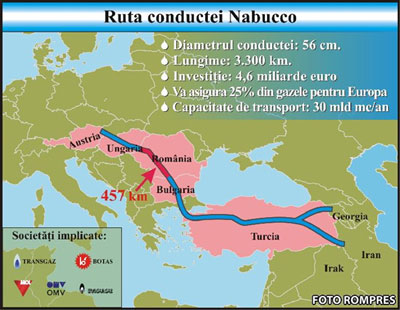
Six companies are currently members of the Nabucco Gas Pipeline International GmbH consortium, each holding 16.7 per cent of the shares: Botgas (Turkey), Bulgargaz (Bulgaria), Transgaz (Romania), MOL (Hungary), OMV (Austria) and RWE (Germany). France’s GDF Suez SA has expressed its interest in taking part in Nabucco’s construction but the final decision will be taken next year depending on whether Turkey and France agree on their interests.
The agreement between Nabucco’s transit states was signed in July after several months of negotiations and after the European Union accepted to integrate this project as a priority within its energy strategy.
According to Reinhard Mitscheck, the general director of the Nabucco Gas Pipeline International, Nabucco has started advanced negotiations with the European Investment Bank (EIB) and the European Bank for Reconstruction and Development (EBRD) in order to establish the project’s financing conditions, with talks set to start with the International Financial Corporation (IFC).
Nabucco will need a varied group of creditors, including international financial institutions, credit export agents and commercial banks. The European Union’s support through the European Energy Program for Recovery (EEPR) will represent an important contribution towards ensuring the needed financing. Moreover, the six consortium partners will contribute their capital to financing the project.
The main goal of the natural gas pipeline that will run from the Turkish-Georgian and Turkish-Iranian borders to Central Europe will be to supply the Eastern and Central European states. The pipeline will have a length of 3,300 kilometers and an estimated cost of EUR 8 bln. According to the EC, 50 per cent of Nabucco’s throughput will be sold on the free market, with the rest set to be reserved in the account of the pipeline’s owners. The sources of supply will be assured by Central Asian states such as Azerbaijan but also probably by Iraq and Iran.
If the construction works start in 2011 the first quantities of natural gas will be delivered starting in 2014 and the throughput will reach its maximum level in 2018-2020.
The project’s essential goal is to reduce the EU states’ dependence on energy supplies from the Russian Federation, a state that currently covers 40 per cent of EU’s natural gas imports. The Russian Federation continues to oppose the project, proposing the South Stream natural gas pipeline that will be built by Russia’s Gazprom and Italy’s ENI as an alternative.
For Romania constructing Nabucco would represent the attainment of the strategic goal of energy independence considering that approximately 25 per cent of the annual natural gas consumption is covered by imports from the Russian Federation.
by Constantin Radut